CLD hit datasets contain tracker and calorimeter measurements from Key4HEP/EDM4hep production at 365 GeV. The schema version is 3.2.2, and the standard hit recipe is pyg-cld-hits-v1. Hit reconstruction is a research workflow.
Physics samples
| Physics sample | TFDS dataset | Training selection |
|---|---|---|
| Top-quark pairs | cld_edm_ttbar_hits | Included in default recipe |
| Fully hadronic WW | cld_edm_ww_fullhad_hits | Included in default recipe |
| Inclusive quark pairs | cld_edm_qq_hits | Included in default recipe |
| ZZ | cld_edm_zz_hits | Additional builder; outside default recipe |
Recipes configure partitions 1--10. The verified Hub selection provides configuration 1 for ttbar, WW, and qq; check other selections separately.
For CLD particle-set studies, the recommended research preset is pyg-cld-hits-heptv2-set-v1; see the evidence and recommendation.
Event view
These views show the same simulated ttbar event (index 0) at 365 GeV in the transverse plane. The particle panel shows the Pandora reference reconstruction from the source event; the hit dataset stores its own training targets.
| Raw detector hits | Pandora reconstructed particles |
|---|---|
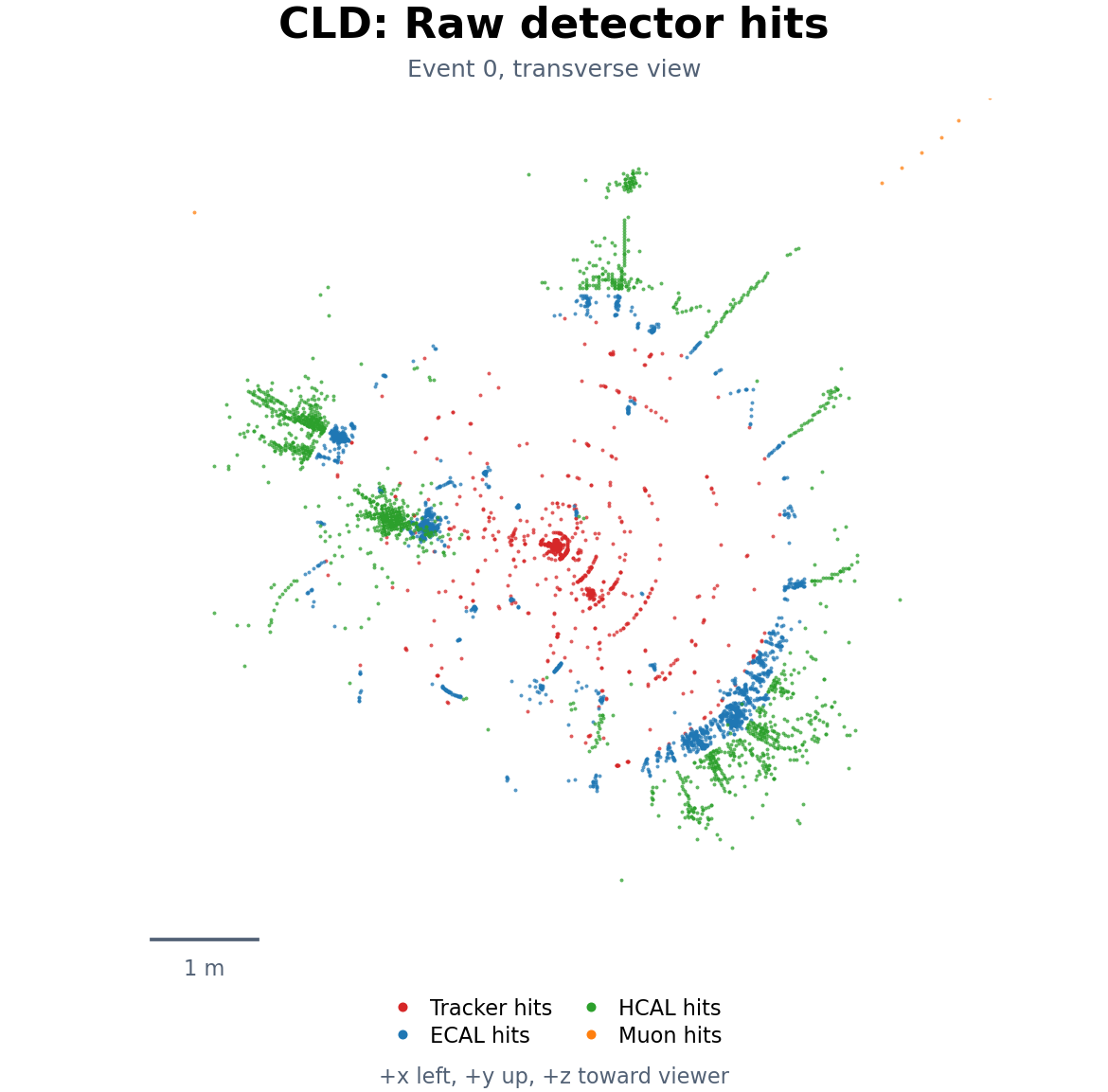 | 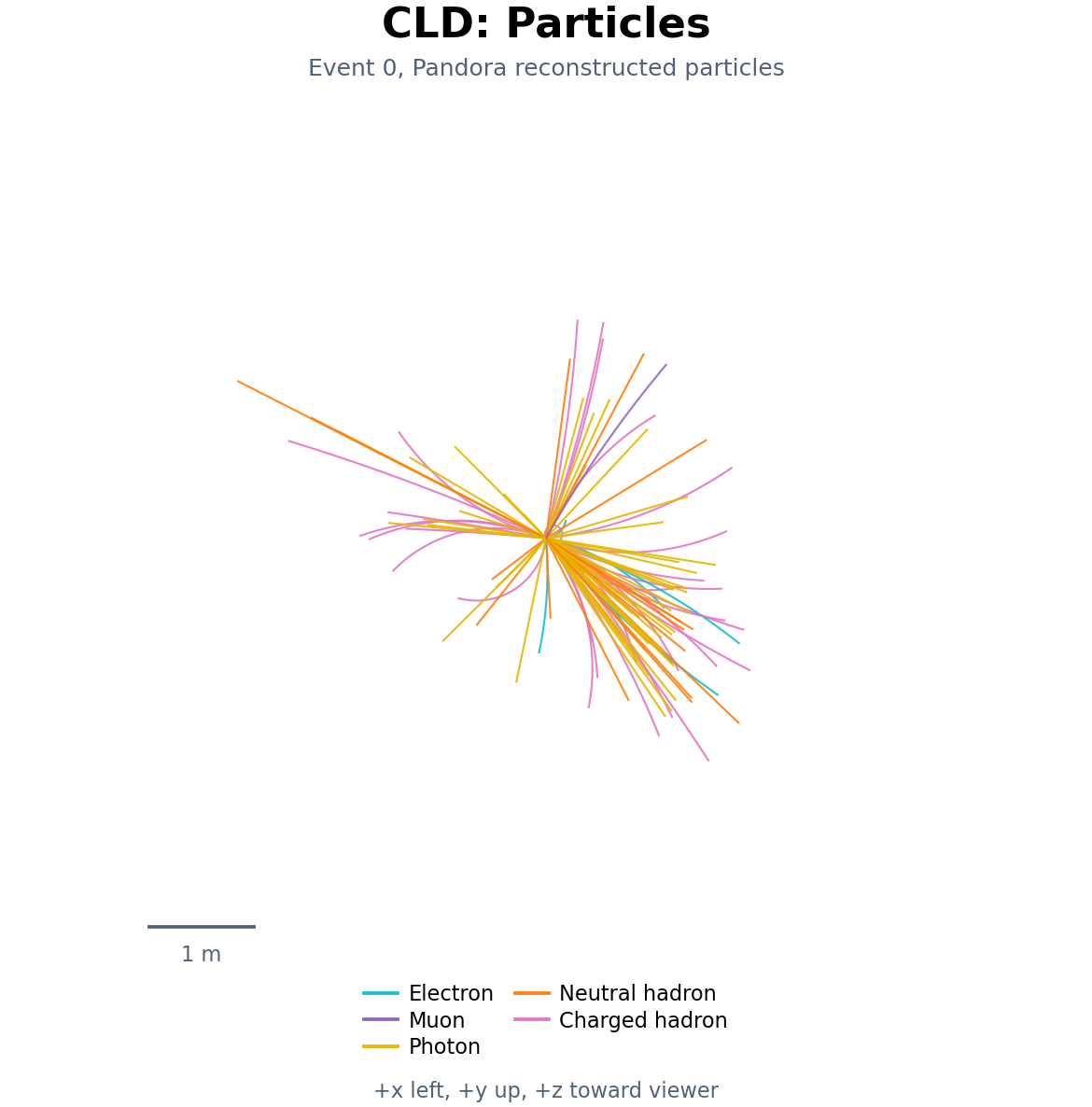 |
All-component overlay, vector input view and vector particle view are available for reuse. See event-view conventions for particle sources, sampling and scale.
Production and related inputs
Follow shared Key4HEP production through strict Parquet validation, then use PROD=cld pixi run tfds_hit. The hit overview explains row targets, placeholder baseline candidates, decoding checks, and memory requirements. Use CLD tracks and clusters for the reconstructed-object representation.