These datasets use reconstructed tracks and calorimeter clusters as input elements. They contain fewer elements per event than hit datasets and provide the default training path for CMS, CLD, and CLIC. ColliderML, MAIA, and IDEA have different reconstruction and validation boundaries, listed below.
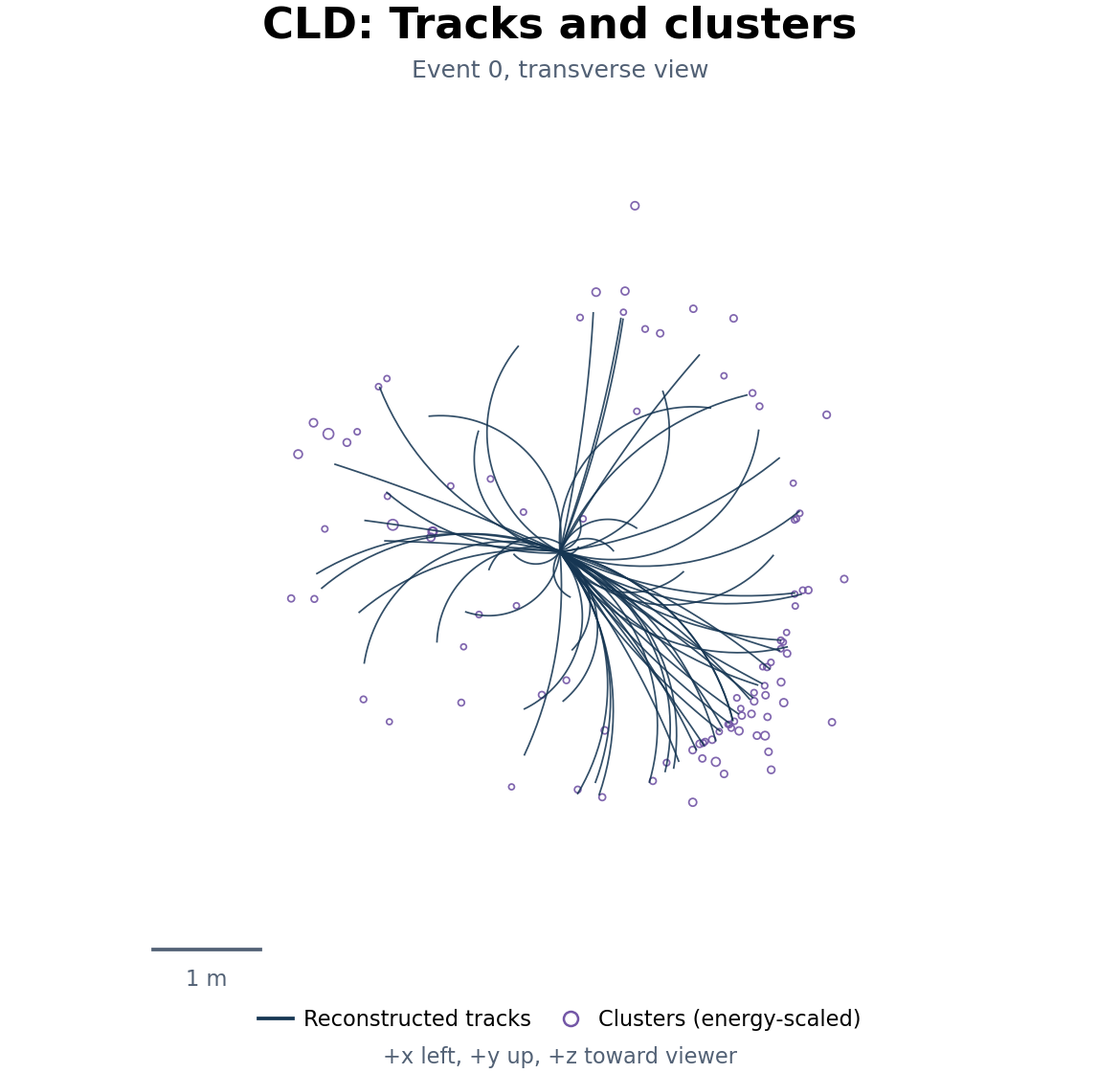
This example shows CLD event 0 in the transverse plane. The detector pages use matching input and particle views; the event gallery provides overlays and reusable assets.
Choose a detector and physics sample
| Detector or dataset family | Physics samples | Workflow |
|---|---|---|
| CMS Run 3 | Top pairs, QCD multijets, hadronic tau pairs; with and without pileup | Supported CMSSW track/cluster path |
| CLD, 365 GeV | Top pairs, fully hadronic WW, inclusive qq, ZZ | Supported Key4HEP track/cluster path |
| CLICdet, 380 GeV | Top pairs, fully hadronic WW, inclusive qq | Supported Key4HEP track/cluster path |
| ColliderML Release 1 | Top pairs without pileup and with approximately 200 pileup interactions | Research workflow with spatial calorimeter clustering |
| MAIA | Top pairs | Partial workflow with data-validation limitations |
| IDEA | Top pairs, fully hadronic WW, inclusive qq | Pipeline validation with truth-seeded proxy tracks |
Open the detector page for exact names, schema versions, recipes, and sample-specific limits. Public availability and configuration partitions are recorded in the catalog.
Use the data
For a first run, download CLD configuration 1 and follow Train a model. To change the relative training exposure of physics samples, use Dataset mixing.
Custom production follows Generate a dataset. CMS has its own postprocessing format; CLD and CLIC share the Key4HEP workflow. The *_pf suffix identifies this representation, but feature definitions and target conventions remain detector-specific.