IDEA is a pipeline-validation workflow using truth-seeded proxy tracks and calorimeter clusters. Its oracle reference does not establish reconstructed-physics performance.
Physics samples
| Physics sample | TFDS dataset | Recipe and published version |
|---|---|---|
| Top-quark pairs | idea_edm_ttbar_pf | 0.2.0 |
| Fully hadronic WW | idea_edm_ww_fullhad_pf | 0.2.0 |
| Inclusive quark pairs | idea_edm_qq_pf | 0.2.0 |
The pyg-idea-pipeline-v1 recipe uses all three samples with configuration 1. The catalog records their public availability.
Event view
These views show the same simulated ttbar event (index 0) at 365 GeV in the transverse plane. Tracks are truth-seeded, and the particle panel shows visible stable truth particles.
| Truth-seeded tracks and clusters | Visible stable truth proxy |
|---|---|
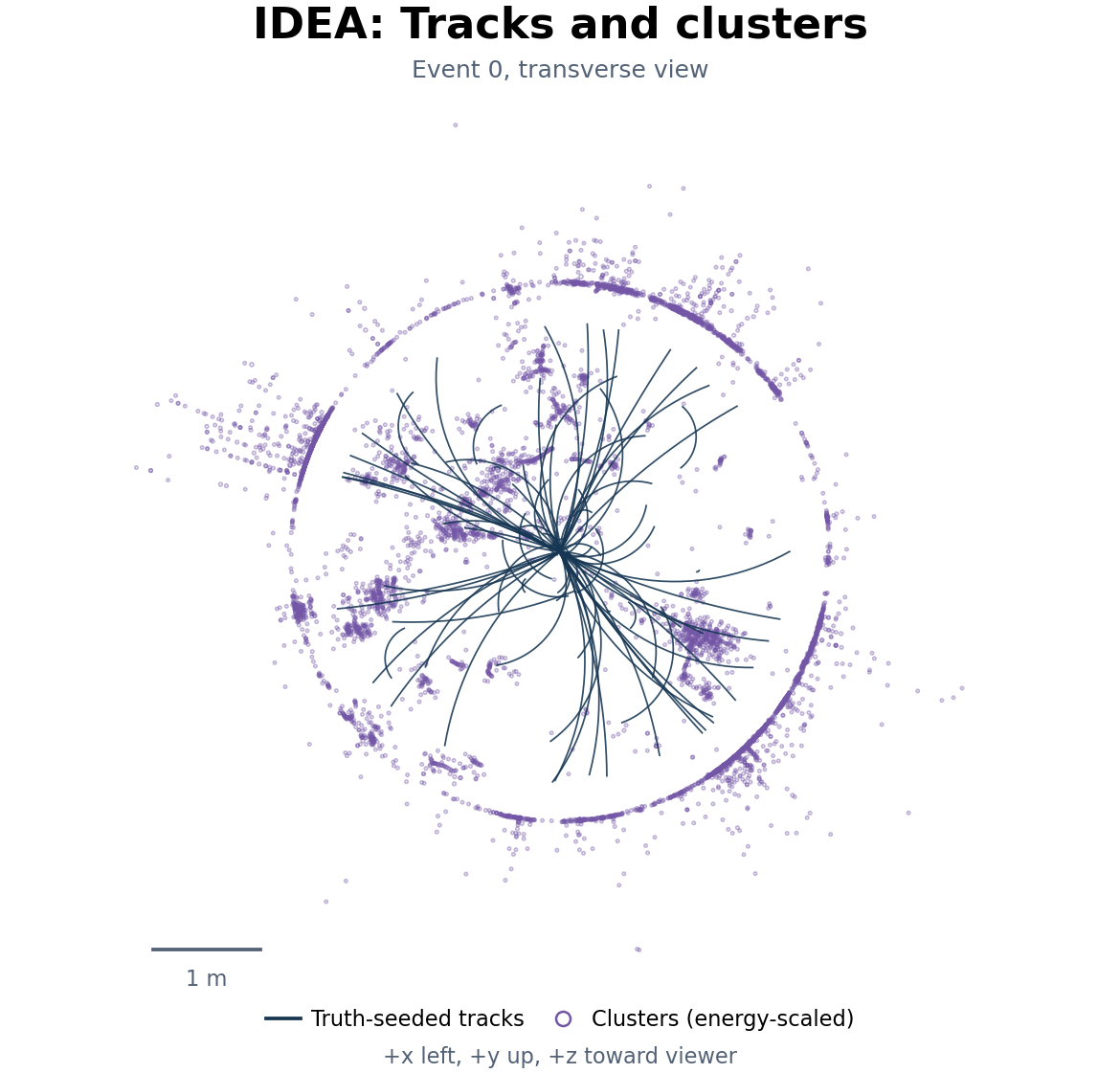 | 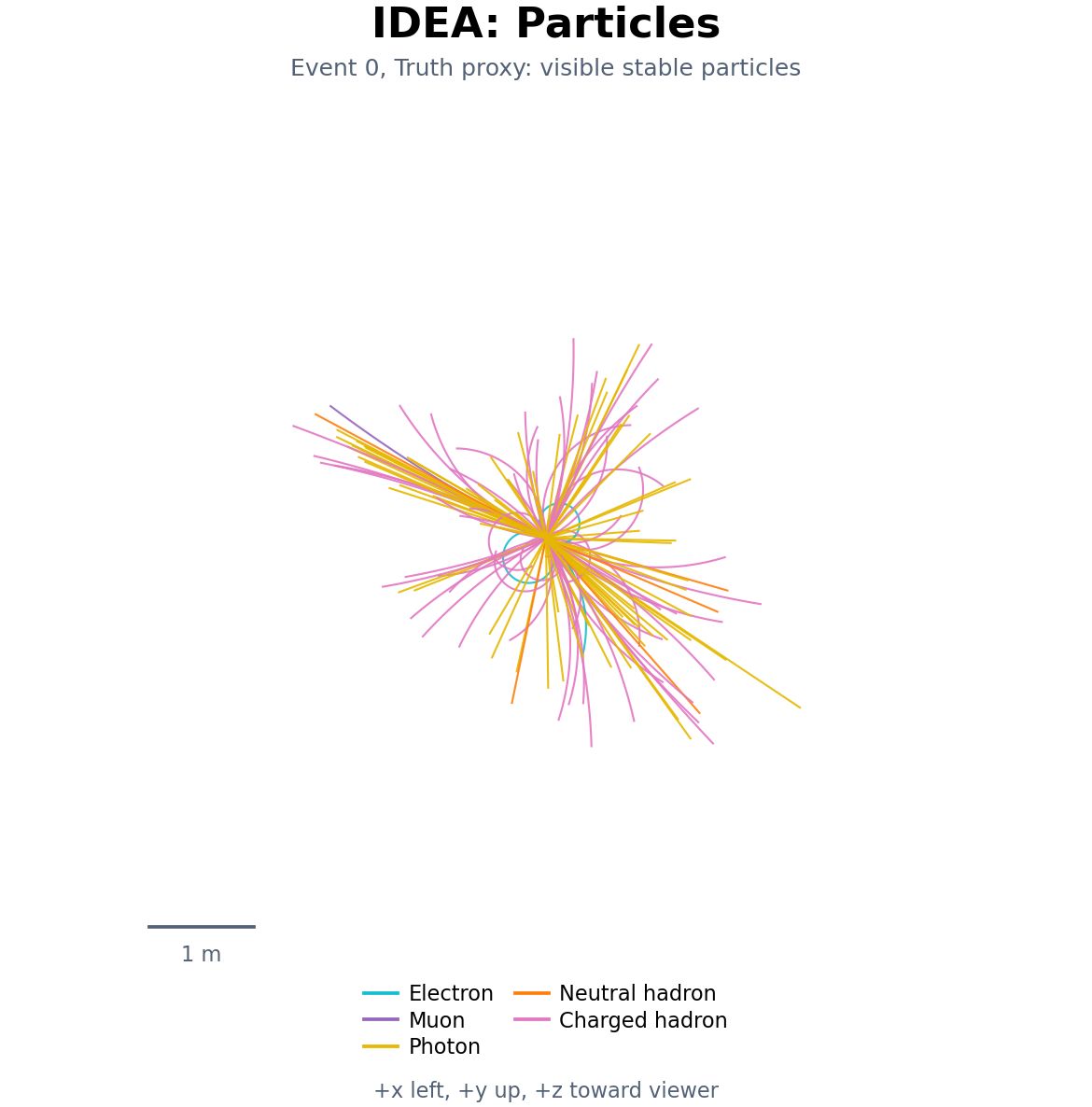 |
All-component overlay, vector input view and vector particle view are available for reuse. See event-view conventions for particle sources, sampling and scale.
Builder and recipe compatibility
The local builders default to 0.2.1, which includes calorimeter-cell shower widths, while the model recipe selects 0.2.0. Align the recipe with the actual rebuilt data before training. Do not relabel a dataset directory to bridge this difference.
For production, review productions.idea in particleflow_spec.yaml and the builders under mlpf/heptfds/idea_pf_edm4hep/, then follow dataset generation. The detector-comparison runbook preserves the separate historical sample inventory and its limitations.