ColliderML Release 1 supplies tracks and spatial calorimeter clusters for top-pair events. This is a research workflow with schema version 1.2.0; it has no PF baseline in the local detector comparison.
Physics samples
| Physics sample | Pileup | TFDS dataset | Model recipe |
|---|---|---|---|
| Top-quark pairs | None | colliderml_ttbar_nopu_pf | pyg-colliderml-v1 |
| Top-quark pairs | Approximately 200 interactions | colliderml_ttbar_pu200_pf | pyg-colliderml-pu200-v1 |
pyg-colliderml-pu0pu200-groups-v1 combines these samples in separate groups with independent batch sizes and optional step weights. See the runnable dataset-mixing example.
Both samples have published configuration-1 data in the catalog; recipes configure partitions 1--10. Use --data_config 1 for the published subset.
Event view
These views show the same simulated no-pileup ttbar event (index 0) in the transverse plane. Inputs are ACTS tracks and spatial calorimeter clusters. The particle panel shows visible primary-leaf truth; allocated training targets are defined by postprocessing.
| Tracks and clusters | Primary-leaf truth proxy |
|---|---|
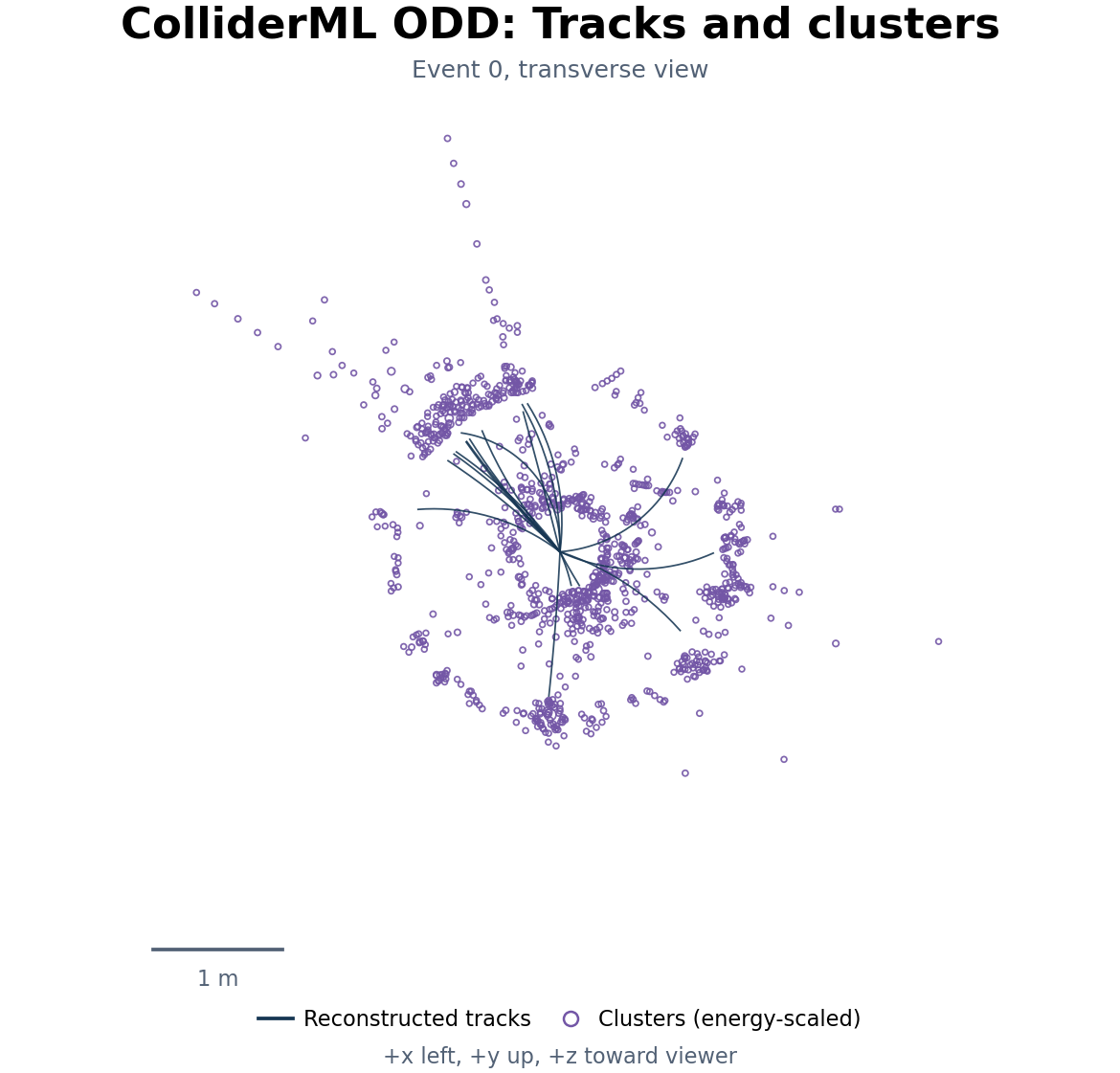 | 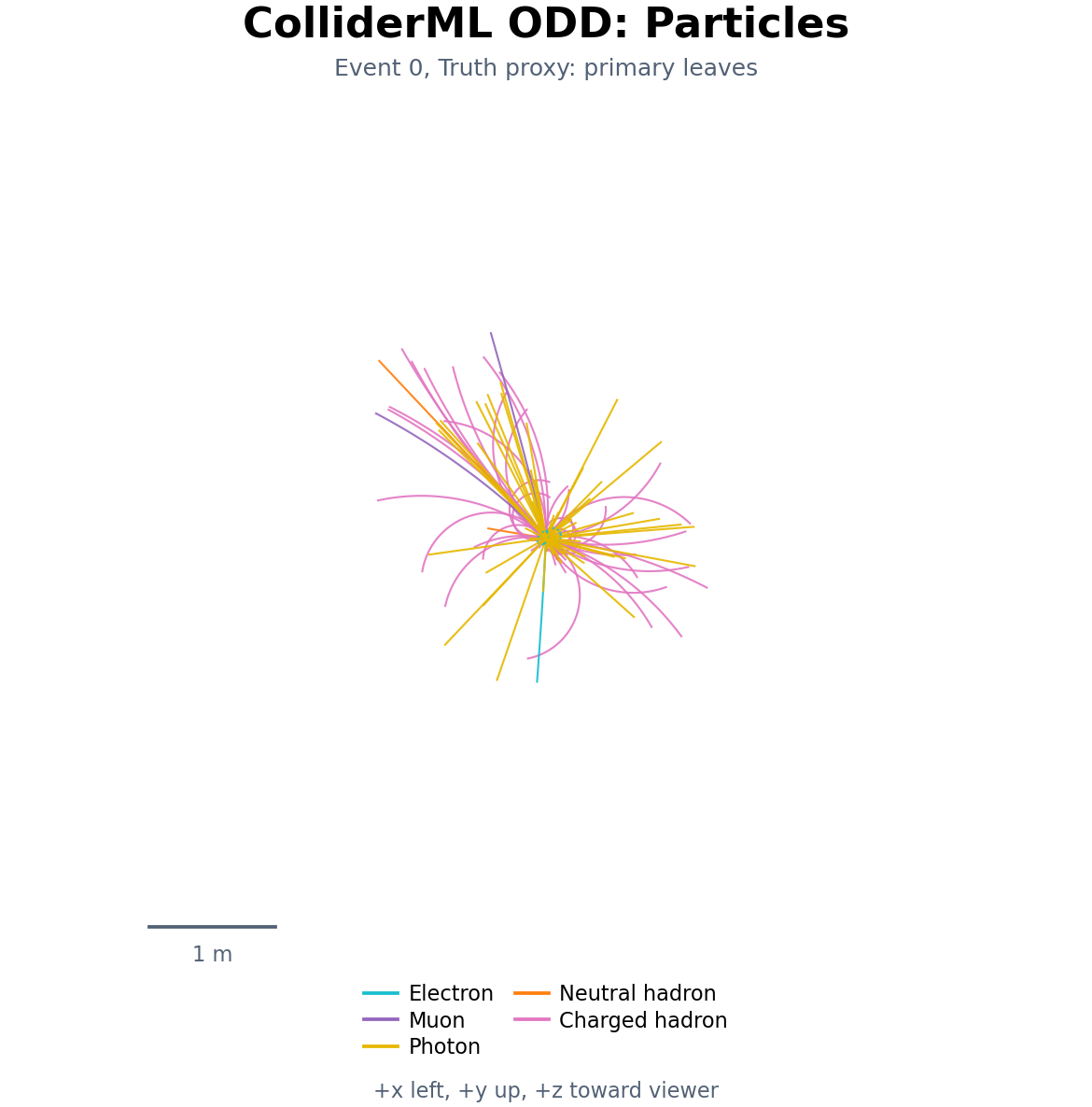 |
All-component overlay, vector input view and vector particle view are available for reuse. See event-view conventions for particle sources, sampling and scale.
Production and validation
productions.colliderml in particleflow_spec.yaml defines the source revision, download and workspace roots, postprocessing, and TFDS mappings. The converter supports radius-graph and CLUE clustering and surrogate-ancestor truth targets. Follow dataset generation with the reviewed source and workspace paths, and use the shared Parquet validator with --detector colliderml.
The detector-comparison runbook records the real-data training check and feature-validation limits. ColliderML hit datasets use separate names and recipes.