ColliderML Release 1 hit datasets use raw tracker and calorimeter hits with one target row per input hit. Both builders use schema version 1.0.0. Pileup membership is carried in the target particle’s ispu feature.
Physics samples
| Physics sample | Pileup | TFDS dataset | Model recipe |
|---|---|---|---|
| Top-quark pairs | None | colliderml_ttbar_hits | pyg-colliderml-hits-v1, pyg-colliderml-hits-set-v1 |
| Top-quark pairs | Approximately 200 interactions | colliderml_ttbar_pu200_hits | Builder exists; no named training recipe |
The TFDS mappings configure partitions 1--10. These samples are not included in the verified public selection; check publication availability before downloading. A custom pileup-200 training recipe requires its own validation.
Event view
These views show the same simulated no-pileup ttbar event (index 0) in the transverse plane. The particle panel shows visible primary-leaf truth; the hit dataset defines its training targets through postprocessing.
| Raw detector hits | Primary-leaf truth proxy |
|---|---|
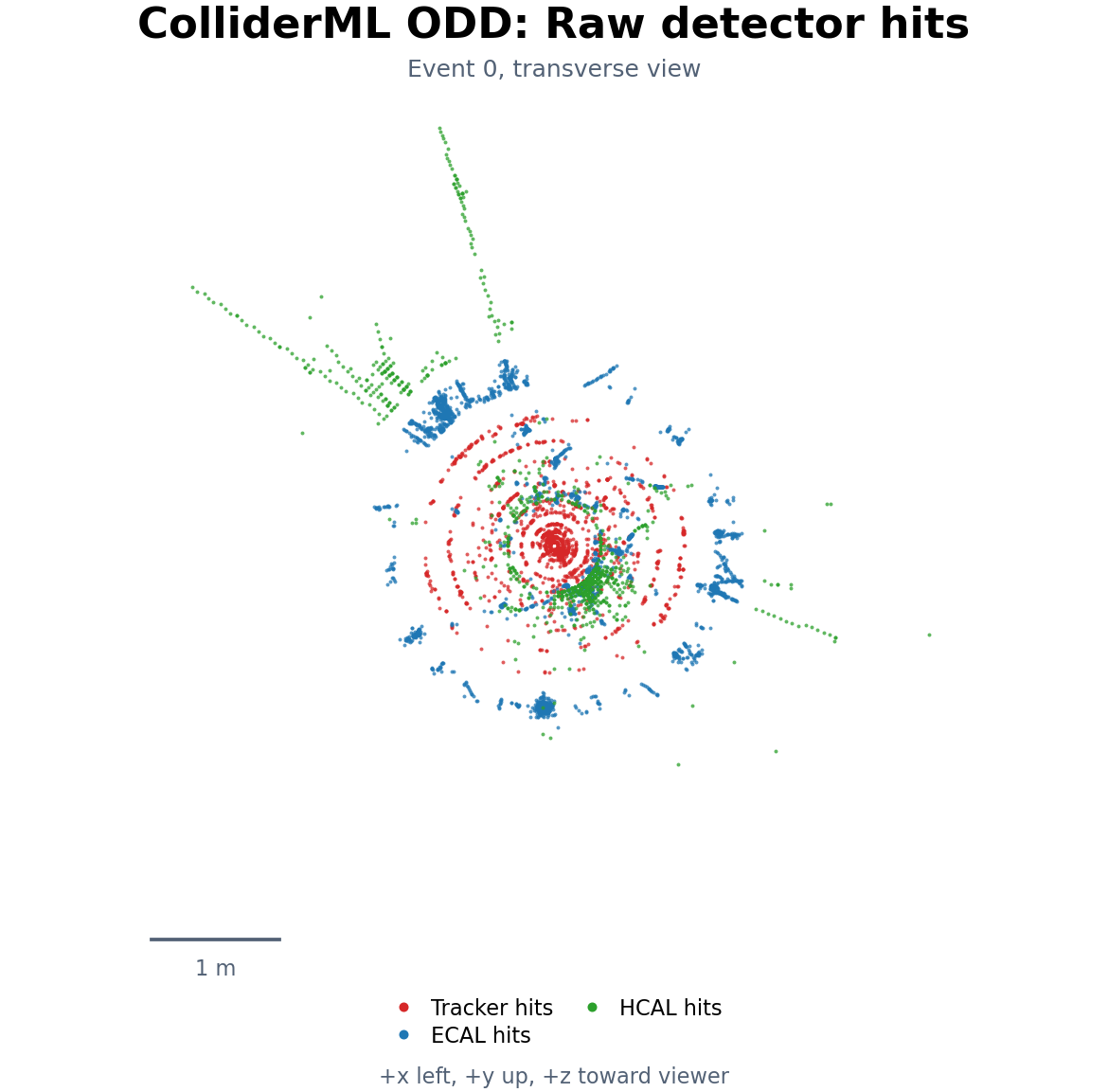 | 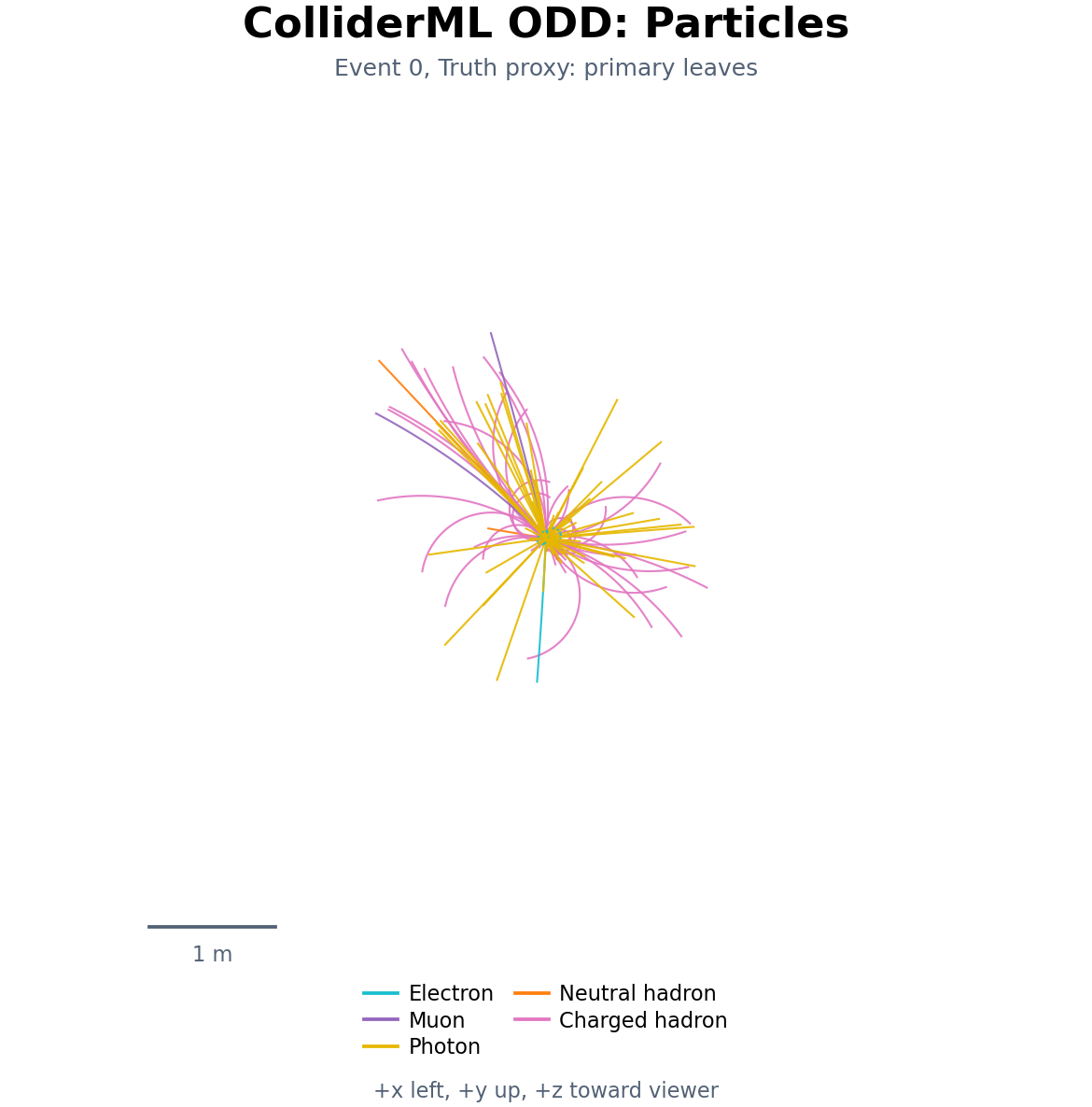 |
All-component overlay, vector input view and vector particle view are available for reuse. See event-view conventions for particle sources, sampling and scale.
Production and related inputs
productions.colliderml.tfds_hit_mapping in particleflow_spec.yaml selects the hit builders under mlpf/heptfds/colliderml_hits/. Use the ColliderML converter and source/workspace configuration with dataset generation; the CLD/CLIC Key4HEP commands do not define ColliderML conversion.
Inspect input sizes and measure memory with a short dedicated hit-model run before scaling. For the clustered representation and its weighted two-group recipe, see ColliderML tracks and clusters.